
Glow – 70mg
$70.00
GHK-Cu 50mg, TB-500 10mg, BPC-157 10mg
GLOW is a synergistic peptide blend developed for research in tissue regeneration and inflammation modulation. By targeting complementary biological repair pathways, it offers a multifaceted approach to cell migration, angiogenesis, and matrix remodeling.
The combined activity of these peptides supports studies on fibroblast activation, oxidative stress, and structural recovery in musculoskeletal, dermal, and intestinal models.
Three Peptides, One Goal: Comprehensive Tissue Repair Research
GLOW combines three powerful regenerative peptides — GHK-Cu, TB-500, and BPC-157 — in a single research formulation. Each component has been individually studied for its healing properties; together, they create a synergistic platform for investigating tissue repair, inflammation modulation, and cellular regeneration across multiple biological systems.
- Triple-peptide synergy: GHK-Cu + TB-500 + BPC-157
- Multi-pathway approach to tissue repair research
- Collagen synthesis, cell migration, and angiogenesis in one blend
- Streamlined protocols with combined administration
- High stability for extended research cycles
For laboratory research use only. Not for human consumption.

TRIPLE-MECHANISM ACTION
How Three Peptides Work Together for Regenerative Research
Each peptide in GLOW targets distinct but complementary pathways. GHK-Cu modulates over 4,000 genes related to tissue repair while delivering copper to cuproenzymes. TB-500 binds G-actin to promote cytoskeletal remodeling and cell migration. BPC-157activates FAK-paxillin signaling and upregulates growth hormone receptor expression in fibroblasts.
- GHK-Cu: Collagen synthesis and gene modulation (4,000+ genes)
- TB-500: Actin binding, cell migration, and angiogenesis
- BPC-157: FAK-paxillin activation and GHR upregulation
- Combined anti-inflammatory action across all three peptides
- Synergistic wound healing and tissue remodeling
For laboratory research use only. Not for human consumption.

MULTI-TISSUE APPLICATIONS
From Skin to Tendon to Gut — Versatile Regenerative Research
GLOW’s unique advantage is its applicability across diverse tissue systems. The blend supports research into orthopedic repair (tendon, ligament, muscle), dermatological regeneration (wound healing, collagen remodeling), and gastrointestinal integrity (gut lining repair). Each component has demonstrated efficacy in these systems individually.
- Tendon, ligament, and muscle repair modeling
- Wound healing and skin regeneration studies
- Gastrointestinal tissue integrity research
- Bone and connective tissue investigations
- Anti-fibrotic and scar reduction mechanisms
- Comparative studies vs. single-peptide protocols
For laboratory research use only. Not for human consumption.

The Science Behind Synergistic Regeneration: Why GLOW Delivers More
GLOW represents a multi-pathway approach to regenerative research — combining three proven peptides into a single, synergistic formulation. Rather than studying each compound in isolation, researchers can now investigate how GHK-Cu, TB-500, and BPC-157 interact and potentially amplify each other’s regenerative effects.
The science behind each component is compelling. GHK-Cu (glycyl-L-histidyl-L-lysine:copper) modulates over 4,000 genes related to tissue growth and inflammation, producing concentration-dependent increases in collagen synthesis (up to 9-fold in wound models). TB-500 (Thymosin Beta-4) binds G-actin to promote cell migration and angiogenesis, with preclinical studies showing accelerated dermal healing and cardioprotective effects. BPC-157activates FAK-paxillin phosphorylation and upregulates growth hormone receptor expression, demonstrating full functional recovery in transected Achilles tendon models.
Together, these mechanisms address multiple phases of tissue repair: inflammation modulation (all three peptides suppress pro-inflammatory cytokines), cell recruitment (TB-500’s chemoattraction, GHK-Cu’s macrophage signaling), matrix remodeling (collagen synthesis and MMP/TIMP balance), and vascularization (VEGF upregulation across all components).
For research teams investigating regenerative medicine, injury recovery, or comparative peptide efficacy, GLOW provides a comprehensive platform. Its triple-peptide design enables studies that would otherwise require multiple compounds, simplifying protocols while maximizing research potential across musculoskeletal, dermatological, and gastrointestinal models.
For research use only. Not for human consumption.
SCIENTIFIC REFERENCES (COMPONENT PEPTIDES)
- GHK-Cu: Maquart FX, et al. In vivo stimulation of connective tissue accumulation by the tripeptide-copper complex glycyl-L-histidyl-L-lysine-Cu2+ in rat experimental wounds. J Clin Invest. 1993;92(5):2368-2376.
- GHK-Cu: Pickart L, Margolina A. Regenerative and Protective Actions of the GHK-Cu Peptide in the Light of the New Gene Data. Int J Mol Sci. 2018;19(7):1987.
- TB-500: Malinda KM, et al. Thymosin beta4 accelerates wound healing. J Invest Dermatol. 1999;113(3):364-368.
- TB-500: Bock-Marquette I, et al. Thymosin beta4 activates integrin-linked kinase and promotes cardiac cell migration, survival and cardiac repair. Nature. 2004;432(7016):466-472.
- BPC-157: Staresinic M, et al. Gastric pentadecapeptide BPC 157 accelerates healing of transected rat Achilles tendon and in vitro stimulates tendocytes growth. J Orthop Res. 2003;21(6):976-983.
- BPC-157: Gwyer D, et al. Gastric pentadecapeptide body protection compound BPC 157 and its role in accelerating musculoskeletal soft tissue healing. Cell Tissue Res. 2019;377(2):153-159.
CERTIFICATE
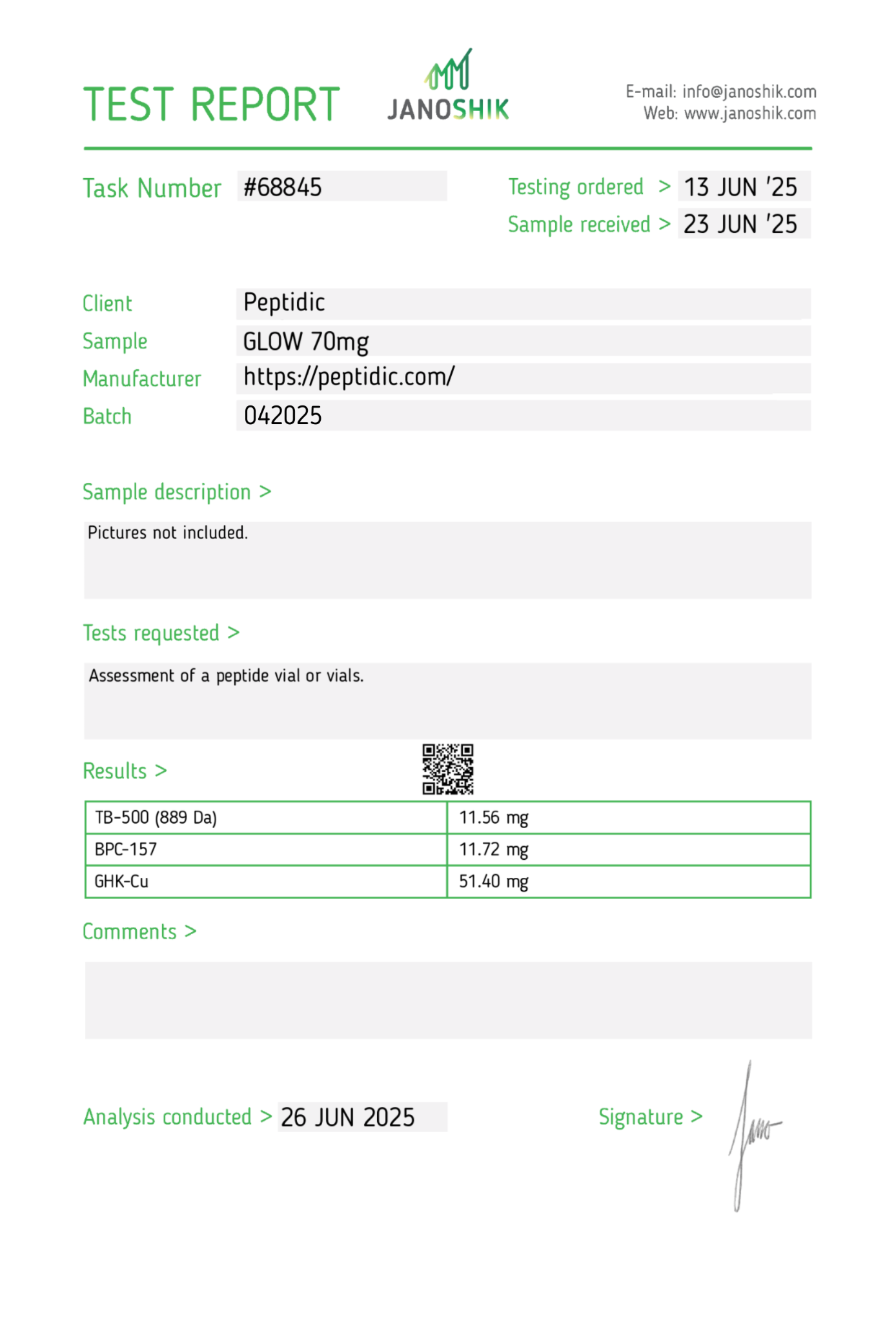
A detailed summary of the analytical profile, purity, and molecular integrity of the research-grade peptide compound.
Be the first to review “Glow – 70mg”
Related products

Anti aging
Anti aging
Anti aging
Skin Support
Anti aging
Muscle Growth
Anti aging
Reviews
There are no reviews yet.