

BPC-157 – 10mg
Original price was: $75.00.$65.00Current price is: $65.00.
BPC-157 is a synthetic pentadecapeptide derived from a gastric protein, widely studied for its role in tissue repair, angiogenesis, and inflammation modulation.
Research suggests its ability to support fibroblast migration, endothelial regeneration, and nitric oxide signaling, making it a candidate of interest in muscle, tendon, and gastrointestinal repair models.
CYTOPROTECTIVE GASTRIC PEPTIDE
The Body’s Natural Repair Signal — Now Available for Research
BPC-157 (Body Protection Compound-157) is a synthetic 15-amino-acid peptidederived from a protective protein found in human gastric juice. Extensively studied for its remarkable tissue-healing and cytoprotective properties, BPC-157 has become one of the most researched regenerative peptides in preclinical science. Its broad healing profile spans gut, tendon, muscle, and beyond.
- 15-amino-acid sequence derived from gastric protein
- Extensively studied in preclinical tissue repair models
- Cytoprotective and anti-inflammatory properties
- Stable in gastric acid — unique among peptides
- High purity (≥99%) for reliable research outcomes
For laboratory research use only. Not for human consumption.

MULTI-PATHWAY HEALING MECHANISM
How BPC-157 Orchestrates Tissue Repair
BPC-157 activates multiple healing pathways simultaneously. It promotes angiogenesis by increasing VEGF expression, enhances nitric oxide production for improved blood flow, and upregulates growth factor receptors (including GHR, ERK1/2 and AKT signaling) in damaged tissue. Simultaneously, it suppresses pro-inflammatory markers — creating an optimal environment for repair.
- Promotes angiogenesis via VEGF upregulation
- Enhances nitric oxide synthesis for vasodilation
- Upregulates growth hormone receptor expression
- Activates FAK and paxillin phosphorylation
- Accelerates tendon fibroblast migration and outgrowth
For laboratory research use only. Not for human consumption.

RESEARCH APPLICATIONS
From Gut to Tendon — Versatile Tissue Repair Research
BPC-157 has demonstrated healing effects across remarkably diverse tissue types in preclinical models. Its gastric origin makes it particularly effective for gut-related research, while its broad mechanism supports investigations into tendon, ligament, muscle, and even neurological repair. Studies show full functional recovery in transected Achilles tendon models.
- Gastrointestinal healing and ulcer repair studies
- Tendon and ligament regeneration modeling
- Muscle injury and recovery research
- Wound healing and skin repair investigations
- Intestinal anastomosis healing studies
- Anti-inflammatory mechanism studies
For laboratory research use only. Not for human consumption.

The Science Behind Body Protection: Why BPC-157 Leads Regenerative Research
BPC-157 has earned its reputation as a versatile tool for tissue repair research. This stable 15-amino-acid pentadecapeptide (GEPPPGKPADDAGLV, M.W. 1419), originally isolated from human gastric juice, has demonstrated healing effects in virtually every tissue type studied — from the gut lining to tendons, muscles, bones, and even the nervous system.
What makes BPC-157 remarkable is its multi-pathway approach to healing. Research demonstrates it promotes tendon fibroblast outgrowth, increases cell survival under oxidative stress, and significantly enhances cell migration via FAK and paxillin phosphorylation. It also upregulates growth hormone receptor expression in tendon fibroblasts, amplifying responsiveness to endogenous growth signals.
In preclinical Achilles tendon transection models, BPC-157 fully improves recovery: biomechanically (increased load to failure and Young’s modulus), functionally (significantly higher Achilles Functional Index values), microscopically (superior formation of fibroblasts, reticulin and collagen), and macroscopically (reestablishment of full tendon integrity). Uniquely among peptides, BPC-157 is stable in gastric acid for over 24 hours — enabling oral research applications.
For research teams investigating wound healing, tissue regeneration, or musculoskeletal repair mechanisms, BPC-157 provides a well-characterized platform with extensive preclinical literature. Its versatility and demonstrated efficacy across multiple tissue systems make it essential for modern regenerative medicine research.
For research use only. Not for human consumption.
SCIENTIFIC REFERENCES
- Staresinic M, et al. Gastric pentadecapeptide BPC 157 accelerates healing of transected rat Achilles tendon and in vitro stimulates tendocytes growth. J Orthop Res. 2003;21(6):976-983.
- Chang CH, et al. The promoting effect of pentadecapeptide BPC 157 on tendon healing involves tendon outgrowth, cell survival, and cell migration. J Appl Physiol. 2011;110(3):774-780.
- Chang CH, et al. Pentadecapeptide BPC 157 enhances the growth hormone receptor expression in tendon fibroblasts. Molecules. 2014;19(11):19066-19077.
- Gwyer D, et al. Gastric pentadecapeptide body protection compound BPC 157 and its role in accelerating musculoskeletal soft tissue healing. Cell Tissue Res. 2019;377(2):153-159.
- Seiwerth S, et al. Stable Gastric Pentadecapeptide BPC 157 and Wound Healing. Front Pharmacol. 2021;12:627533.
CERTIFICATE
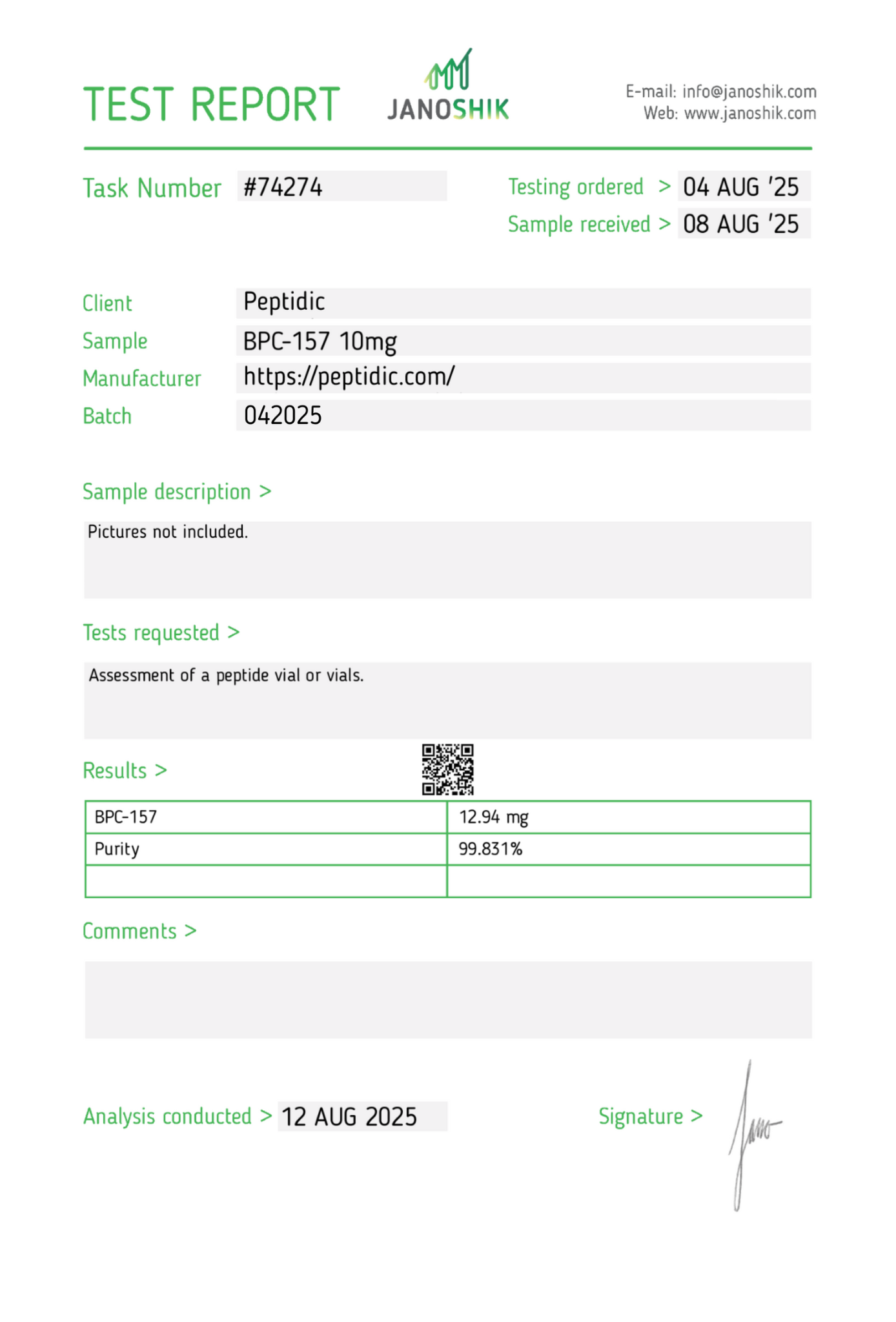
A detailed summary of the analytical profile, purity, and molecular integrity of the research-grade peptide compound.
Be the first to review “BPC-157 – 10mg”
Related products

Anti aging
Anti aging
Blends
Anti aging
Skin Support
Anti aging
Reviews
There are no reviews yet.