

Melanotan II – 10mg
Original price was: $65.00.$55.00Current price is: $55.00.
Melanotan II is a synthetic cyclic heptapeptidedeveloped for research on melanocortin receptor activity, particularly MC1and MC4.
It is commonly used in studies exploring mechanisms of pigmentation, appetite regulation, and neuroendocrine signaling.
A Synthetic α-MSH Analog for Pigmentation Research
Melanotan II is a synthetic cyclic heptapeptide analog of α-melanocyte-stimulating hormone (α-MSH). Developed at the University of Arizona, this lactam-bridged molecule with the structure Ac-Nle-c[Asp-His-D-Phe-Arg-Trp-Lys]-NH₂ targets melanocortin receptors — particularly MC1R and MC4R — making it a valuable tool for researchers investigating pigmentation mechanisms, appetite regulation, and neuroendocrine signaling pathways.
- Synthetic cyclic analog of α-melanocyte-stimulating hormone
- Targets MC1R (pigmentation) and MC4R (neuroendocrine)
- Lactam-bridged heptapeptide structure for enhanced stability
- Superpotent melanotropic activity in research models
- High purity for reliable experimental outcomes
For laboratory research use only. Not for human consumption.

MELANOCORTIN SIGNALING
How Melanotan II Activates Pigmentation Pathways
Melanotan II binds to melanocortin-1 receptors (MC1R) on melanocytes, triggering intracellular cAMP signaling cascades that activate protein kinase A (PKA), CREB transcription factors, and ultimately the master regulator MITF. This pathway upregulates tyrosinase expression — the rate-limiting enzyme for melanogenesis — promoting eumelanin synthesis, the photoprotective dark pigment. Its activity at MC4R has also made it relevant for appetite regulation and neuroendocrine research.
- Activates MC1R → cAMP → PKA → CREB → MITF pathway
- Upregulates tyrosinase and melanogenic enzymes
- Stimulates eumelanin synthesis (photoprotective pigment)
- MC4R activity relevant to appetite and energy studies
- Cyclic structure provides enhanced receptor binding stability
For laboratory research use only. Not for human consumption.

RESEARCH APPLICATIONS
From Pigmentation Studies to Neuroendocrine Research
Melanotan II has become a key compound for researchers exploring the melanocortin system — one of the body’s most important regulatory networks. Its non-selective agonist activity at MC1R, MC3R, MC4R, and MC5R makes it valuable for studies spanning pigmentation biology, appetite and feeding behavior, sexual function pathways, and broader neuroendocrine signaling mechanisms.
- Pigmentation and melanogenesis pathway studies
- Melanocortin receptor characterization and binding
- Appetite regulation and energy homeostasis research
- Neuroendocrine signaling pathway exploration
- Central nervous system melanocortin effects
- Drug delivery and conjugate research applications
For laboratory research use only. Not for human consumption.

The Science Behind Melanocortin Research: Why Melanotan II Matters
Melanotan II (MT-II) is a synthetic cyclic heptapeptide developed as an analog of α-melanocyte-stimulating hormone (α-MSH). Created at the University of Arizona by researchers including Hruby and Hadley, this compound has since become an important research tool for understanding the melanocortin receptor system — a network that influences pigmentation, appetite, energy balance, and sexual function.
The peptide’s primary mechanism involves MC1R activation on melanocytes, which triggers adenylyl cyclase activity and cAMP generation. This leads to protein kinase A (PKA) activation, CREB phosphorylation, and increased transcription of MITF — the master regulator of melanocyte differentiation. MITF subsequently upregulates tyrosinase, TYRP1, and DCT expression, driving eumelanin biosynthesis. Unlike natural α-MSH, Melanotan II’s lactam-bridged cyclic structure provides enhanced enzymatic stability and prolonged receptor binding.
Beyond pigmentation, Melanotan II’s activity at MC4R has opened research avenues into appetite regulation, energy homeostasis, and neuroendocrine function. Studies have demonstrated its effects on dopaminergic signaling in the ventral tegmental area and nucleus accumbens, as well as its interactions with oxytocinergic pathways. This multi-receptor profile makes it valuable for researchers studying the broader melanocortin system and its role in metabolic and behavioral regulation.
For research teams investigating pigmentation biology, melanocortin receptor pharmacology, or neuroendocrine signaling, Melanotan II provides a well-characterized tool with decades of scientific literature supporting its receptor binding properties and biological activity in research models.
For research use only. Not for human consumption.
SCIENTIFIC LITERATURE
- Dorr RT, et al. Evaluation of melanotan-II, a superpotent cyclic melanotropic peptide in a pilot phase-I clinical study. Life Sci. 1996;58(20):1777-1784. DOI: 10.1016/0024-3205(96)00160-9
- García-Borrón JC, et al. MC1R, the cAMP pathway, and the response to solar UV: extending the horizon beyond pigmentation. Pigment Cell Melanoma Res. 2014;27(5):699-720. DOI: 10.1111/pcmr.12257
- Wessells H, et al. Melanocortin receptor agonists, penile erection, and sexual motivation: human studies with Melanotan II. Int J Impot Res. 2000;12(Suppl 4):S74-79. DOI: 10.1038/sj.ijir.3900582
- Hadley ME, Dorr RT. Melanocortin peptide therapeutics: historical milestones, clinical studies and commercialization. Peptides. 2006;27(4):921-930. DOI: 10.1016/j.peptides.2005.01.029
- D’Orazio JA, et al. Melanocortin 1 Receptor: Structure, Function, and Regulation. Front Genet. 2016;7:95. DOI: 10.3389/fgene.2016.00095
CERTIFICATE
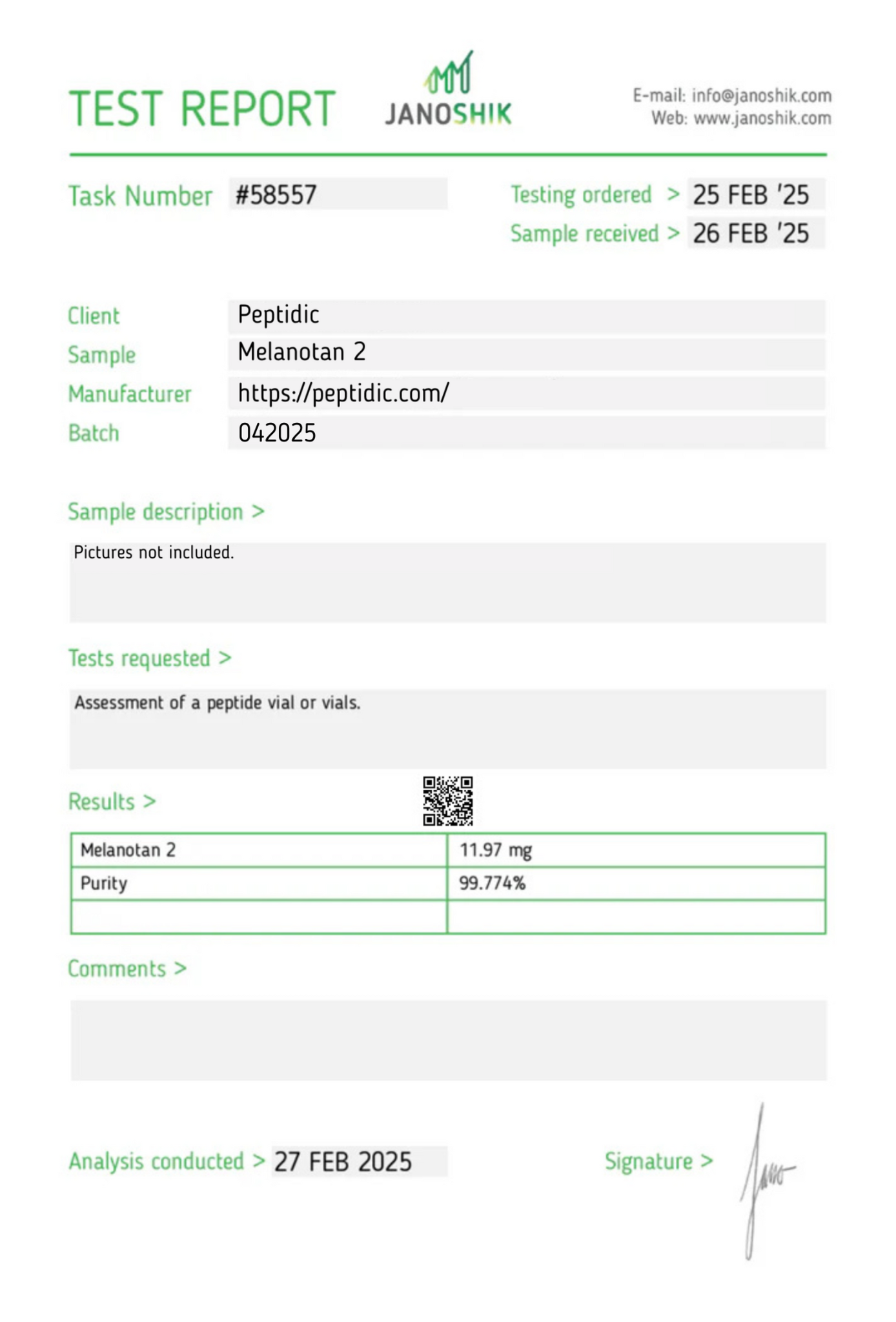
A detailed summary of the analytical profile, purity, and molecular integrity of the research-grade peptide compound.
Be the first to review “Melanotan II – 10mg”
Related products

SEXUAL HEALTH
Reviews
There are no reviews yet.